Polytechnic Admission | Career Guide
FCFMT Opens 2026/2027 ND Hydrology and Water Resources Management Admission: Requirements, Career Opportunities and Why Students Should Consider It
By OGB Admission Hub Editorial Team | 10 November 2026
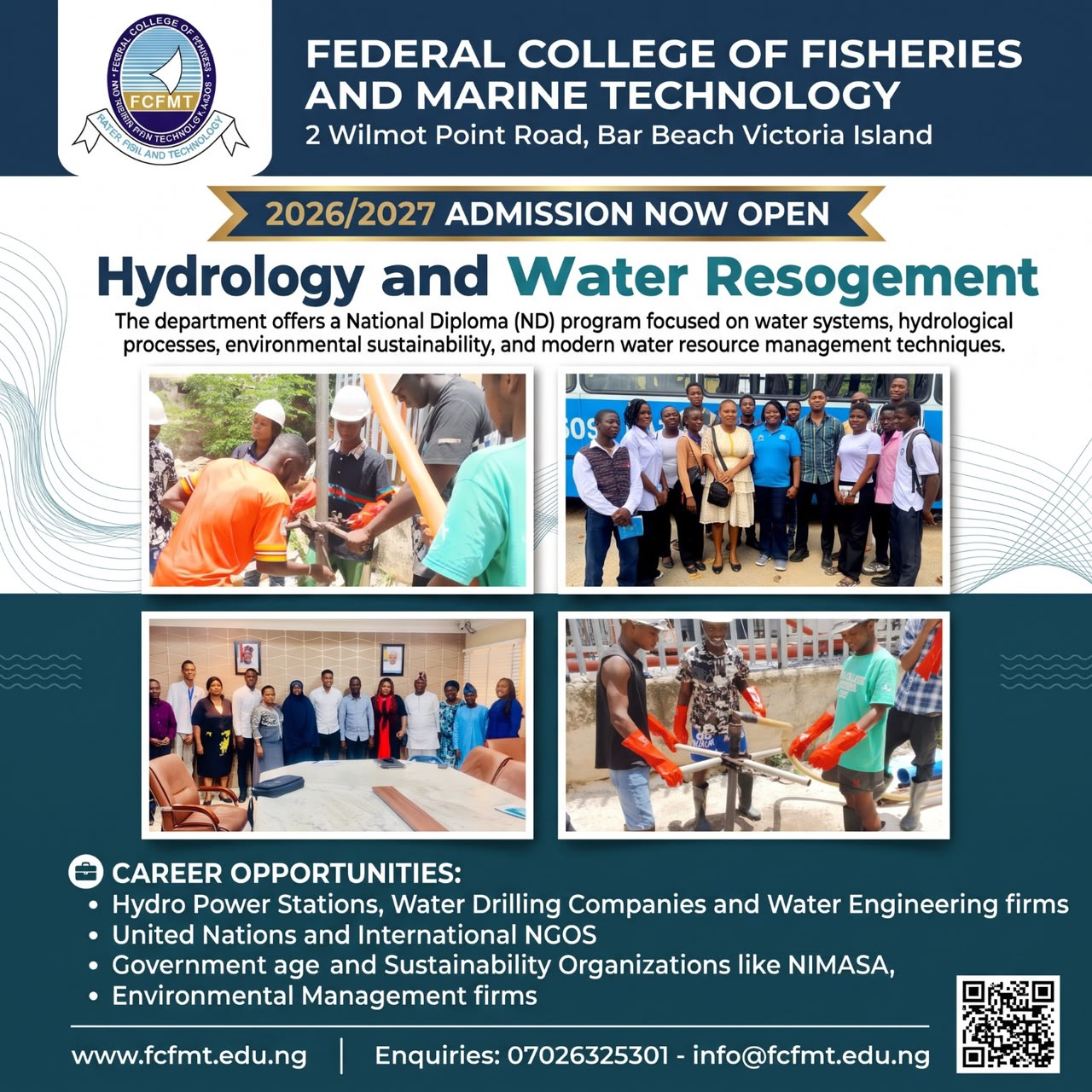
The Federal College of Fisheries and Marine Technology (FCFMT), Victoria Island, Lagos , is promoting admission into its National Diploma (ND) in Hydrology and Water Resources Management for the 2026/2027 academic session. The college's latest admission flyer presents the programme as a practical route into water systems, environmental protection and the sustainable management of one of society's most essential resources.
FCFMT's official website currently carries a 2026/2027 Admission in Progress announcement, while the programme page confirms that the National Diploma is designed for the technical study and management of water resources. The 2026/2027 admission form is still on sale now. Interested applicants should apply through the official FCFMT application portal and confirm the current payment details and closing date directly with the college before paying.
What Is Hydrology and Water Resources Management?
Hydrology is the science of water: how rain, rivers, lakes, reservoirs and underground water move through the environment, how water quality changes, and how human activities affect water supplies. Water Resources Management applies this knowledge to practical challenges such as clean water access, sustainable water use, pollution, flooding, drought and drainage.
This is not a course that only teaches students about fish or boats. It deals with the water systems on which homes, farms, factories, cities, dams and public health depend.
Why Should Students Aspire to Study the Course?
1. Water management addresses real challenges in Nigeria
Flooding, blocked drainage channels, erosion, drinking-water quality, unreliable water supply and drought are real challenges for many communities. Learning how to measure water flow, test samples and understand drainage systems can prepare students to contribute to practical solutions. This does not mean a diploma alone makes someone a licensed engineer or guarantees a government job.
2. It combines science with practical fieldwork
According to the college's programme description, students are trained in water-quality and sediment analysis, managing hydrological data, groundwater studies, stream-flow measurement, gauging-station operations and flood-risk assessment. These activities can appeal to students who enjoy Geography, Physics, environmental science, Mathematics and practical field investigations.
3. The skills can support many sectors
Graduates may pursue appropriate entry-level technical roles, subject to employers' requirements, with water utilities, river-basin development and drainage projects, environmental consulting companies, drilling and groundwater businesses, hydro-power operations and public-sector water or environmental agencies.
The college's promotional flyer also mentions international NGOs, United Nations-related development work and NIMASA among possible career directions. Such organisations should be understood as potential sectors of interest, not guaranteed employers or automatic eligibility for every ND graduate.
4. It can be a foundation for further study
Students who perform well may explore progression opportunities in related disciplines, subject to institutional entry requirements. Possible academic directions include higher-level studies in hydrology, water resources, environmental management, geography, geoscience or related engineering fields. Admission into an HND or degree programme is not automatic; candidates must confirm that a receiving institution accepts their ND qualification.
5. It offers opportunities beyond salaried employment
With experience, suitable professional supervision and any required licences, graduates can develop services in environmental data collection, water-quality monitoring support, field sampling, drainage assessments and related technical projects. The long-term opportunity lies in building expertise and a credible portfolio rather than assuming immediate high salaries.
What Students Will Learn at FCFMT
The college's official course page identifies learning outcomes such as:
Understanding rainfall, rivers, groundwater, catchments and watershed management.
Measuring stream flows and operating hydrological observation instruments.
Analysing water quality, pollutants, sedimentation and erosion.
Maintaining data for dams, reservoirs and water-resource planning.
Assessing urban drainage, flooding, drought and environmental risks.
Using computer systems and basic data-processing techniques for water monitoring.
Students should expect a mix of classroom learning and applied technical work. The exact modules, laboratory schedule and field-placement arrangements should be confirmed with the college.
Is FCFMT's ND Hydrology Programme Accredited?
Yes. The National Board for Technical Education (NBTE) public programme register lists ND Hydrology & Water Resource Management at the Federal College of Fisheries and Marine Technology, Victoria Island, with full accreditation active until 18 November 2029 in the register reviewed in November 2026. This is institution- and programme-specific confirmation, rather than an assumption based only on a promotional flyer.
FCFMT Hydrology and Water Resources Management Admission Requirements
FCFMT's course-specific admission page specifies five O'Level credit passes in not more than two sittings , including:
English Language
Mathematics
Physics or Geography
Two additional Science subjects
At least passes in Chemistry and Biology as specified in the school's published requirements.
The five credits and the Chemistry/Biology passes may overlap where the same subjects satisfy both conditions. Candidates should confirm their exact subject combination and qualification route with the Admissions Office before applying. The programme page also describes a separate recognised preliminary-ND qualification route.
What About JAMB Cut-Off and Subject Combination?
FCFMT's page titled 2026/2027 Admission Exercise lists an institutional UTME minimum of 100 , first-choice selection and O'Level upload to JAMB CAPS. However, that page still refers to the 2025/2026 UTME in its body. Because of this outdated wording, OGB advises candidates to verify the applicable 2026 UTME minimum, approved JAMB subject combination and programme-specific conditions directly with the college before relying on the stated figure.
A minimum qualifying score does not guarantee admission. Applicants also need to satisfy programme requirements, institutional screening and the relevant admission procedures.
How to Apply for FCFMT 2026/2027 Admission
Check the official FCFMT website for the current 2026/2027 admissions notice.
Review the Hydrology and Water Resources Management ND requirements .
Use the college's linked official application portal only after confirming that the relevant application window is active.
Check your JAMB institution choice and ensure the required O'Level results are uploaded to JAMB CAPS.
Follow the school's application, screening and payment instructions, retaining all acknowledgements and receipts.
The flyer provided to OGB did not state an application fee or a closing date. We have not invented either. Applicants should confirm current fees and deadlines on the official portal.
Who Is Best Suited to This Course?
Hydrology and Water Resources Management may particularly suit students who enjoy science, Geography, environmental problem-solving, working with measurements and data, and occasionally participating in outdoor fieldwork. Those who prefer only desk-based work or are uninterested in water and environmental systems should examine the curriculum carefully before choosing it.
Students should compare the course with related options such as Environmental Science, Geology, Civil Engineering, Oceanography and Marine Technology. Each is a distinct field with different qualifications and professional opportunities; this ND is not a substitute for a professional engineering degree.
FCFMT Location and Official Contact Details
Institution: Federal College of Fisheries and Marine Technology (FCFMT) Address: 2 Wilmot Point Road, Bar Beach, Victoria Island, Lagos State, Nigeria Official website: fcfmt.edu.ng Course information: ND Hydrology and Water Resources Management Application portal: applications.fcfmt.edu.ng Email: info@fcfmt.edu.ng Flyer enquiry number: 07026325301 (confirm through the official school channels before sending any documents or funds).
OGB Admission Hub's Advice to Prospective Students
Do not judge a course solely by how familiar its name sounds. A good programme should be chosen for genuine interest, academic ability, programme accreditation, practical training opportunities and a realistic career plan. Water resources are important to homes, agriculture, public health, environmental safety and industry, making this a field worth exploring for students who enjoy applied science.
For help understanding admission eligibility and comparing institutions, visit the OGB Admission Hub Eligibility Checker and Polytechnic and ND Institution Directory . Note that a preliminary eligibility check does not override the college's official admission decisions.
Verified sources: FCFMT Official Website | Programme Description and Requirements | Admission Guidelines | NBTE Accreditation Register .
OGB Admission Hub — Beyond Information. Beyond Boundaries. From Preparation to Admission.
Admission news, straight to your inbox.
Choose school-specific email alerts →
Subscribe to OGBAdmissionHub for admission news, school forms and important deadlines.
What you can do next
See an error or outdated date? Request a correction or read our editorial policy.
THE CONVERSATION
Questions & comments
Share your thoughts or ask a question about this update. Use Reply below a specific comment to respond directly to that reader.